Why affordability constrains one market while scarcity drives another.
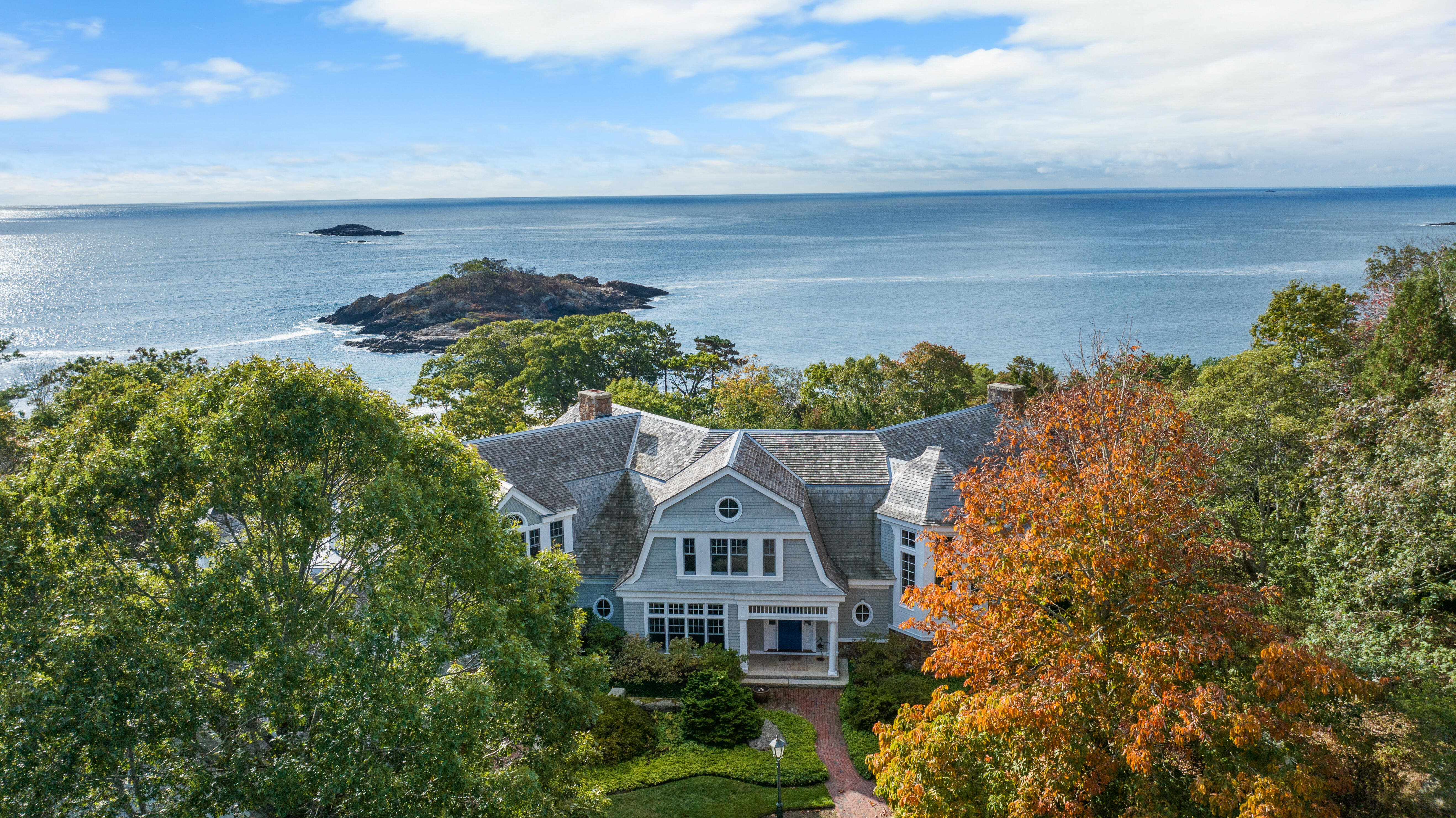
For the past several months, I've been trying to reconcile two seemingly contradictory sets of housing statistics. Nationally, home sales are stagnant, affordability is deteriorating, and consumer confidence remains near historic lows. Yet at LandVest, where our business is concentrated in New England's luxury markets, we're seeing a very different picture.
So, why is New England's luxury housing market telling a different story?
Last November, I described what I called the bimodal economy—the widening divide between the haves and the have-nots. Traditional indicators, I argued, were masking two realities: households with appreciating assets, particularly equities and real estate, were building wealth, while those without were struggling with inflation, borrowing costs, and declining purchasing power.
A year later, that division is increasingly evident in luxury residential real estate.
One Economy. Two Housing Markets.
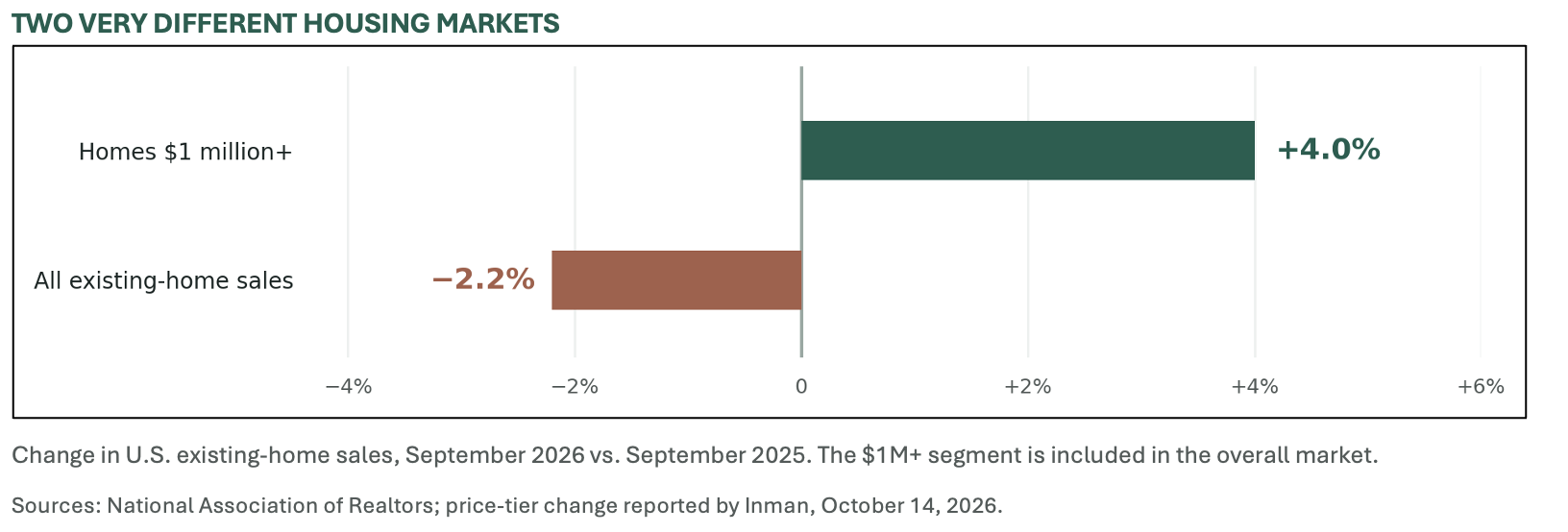
According to the National Association of Realtors, existing-home sales declined 2.2% year over year in September, yet sales of homes priced above $1 million rose 4%. The national median sale price increased 1.3%.
How can prices rise when fewer people are buying?
Part of the answer is what we're measuring. When higher-priced transactions make up a larger share of sales, the median can rise even while much of the market struggles.
A recent Wall Street Journal article, “America's New Housing Market Is All About Luxury—and It Runs on Cash,” reported that luxury-home prices outperformed starter-home prices in 33 of the nation's 50 largest metropolitan markets.
I've spent much of my career examining national and regional housing averages. They're useful, but increasingly tell us less about conditions in any particular market.
The housing market has become K-shaped.
Affordability Versus Financial Flexibility
The University of Michigan's consumer sentiment index finished October at 48.0, compared with 53.6 a year ago. Americans remain remarkably pessimistic about their finances.
The average 30-year mortgage rate stood at 7.24% on October 29, more than a full percentage point above a year earlier. For buyers dependent on financing, the monthly payment determines what they can afford. Many are delaying purchases, scaling back, or leaving the market.
Wealthier buyers face different constraints. Appreciated portfolios, home equity, and the ability to make substantial down payments—or pay cash—offer flexibility. Wealth is not the same as liquidity, and affluent buyers aren't immune to higher rates. But the choices available to buyers at opposite ends of the market are plainly different.
And that brings us to the most important distinction.
Motivated by Scarcity
At the lower and middle ends of the market, buyers are increasingly motivated by affordability. At the upper end, many are motivated by scarcity.
Someone considering an exceptional waterfront property on the Maine coast, a historic estate in Concord, or a distinctive country property in Woodstock may care less about a half-point move in mortgage rates than whether that particular property will ever be available again. After all, you can refinance a mortgage. You cannot necessarily replace an iconic property.
There is an important distinction between scarcity and rarity. Scarcity means too few homes are available; rarity means a property has qualities that cannot readily be replicated. Extraordinary land, protected views, water frontage, architecture, and location can command premiums. But an expensive house isn't necessarily an exceptional one.
We're seeing the divergence in our own business: LandVest's pending transaction count was up 6% over the same period that national pending sales declined. Still, luxury is no guarantee of liquidity. Buyers remain discriminating. An ordinary property with an extraordinary asking price is another matter entirely, and pricing must be supported by evidence.
The Bigger Picture
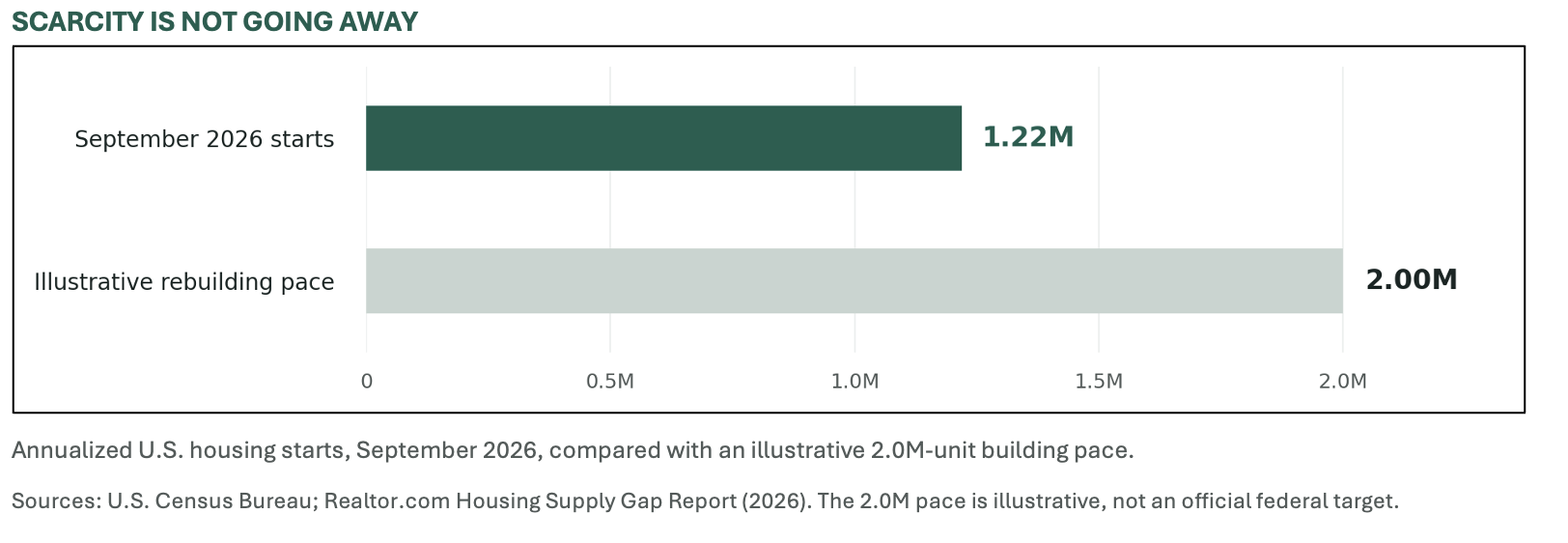
There's a troubling implication to this divided market: strength in luxury real estate should not be confused with the health of housing overall. September housing starts ran at an annualized 1.22 million units, down from 1.32 million a year earlier. Realtor.com estimates a national housing deficit exceeding 4 million homes; others put it at 6–8 million. Many economists believe we need closer to 2 million new units a year over the coming decade to make meaningful progress.
We are constraining housing supply while higher borrowing costs limit ordinary households' ability to buy. I considered this divide unsustainable a year ago, and I remain concerned about its longer-term consequences. A healthy housing market needs broad participation, not simply strength at the top.
The Takeaway
For buyers and sellers, national averages are becoming less useful in valuing individual properties. Local knowledge, realistic pricing, property quality, and an understanding of buyer motivations matter more than ever.
At LandVest, our business has always been about understanding what makes a property exceptional. In this market, that expertise is particularly valuable.
Ultimately, the most important question in real estate today is no longer simply, “How is the housing market?” You first need to ask, “Which housing market?”
At one end, buyers are asking whether they can afford the house. At the other, they're asking whether they can afford to miss out on it.
About Joseph L. Taggart

Joseph L. Taggart is President & CEO of LandVest and serves as the firm’s chief economist. A Yale-trained economist with more than 25 years of experience analyzing housing and macroeconomic trends, he provides perspective on the economic forces shaping housing markets, luxury real estate, and land and timber investment markets across the United States.



 To landvest.com





Follow Us on Social Media