.jpg)
For years, the housing industry has been waiting for the “Silver Tsunami”— Baby Boomers (and the Silent Generation) downsizing from their large homes, and releasing a wave of long-held luxury real estate to the next generation of buyers.
It still hasn’t happened.
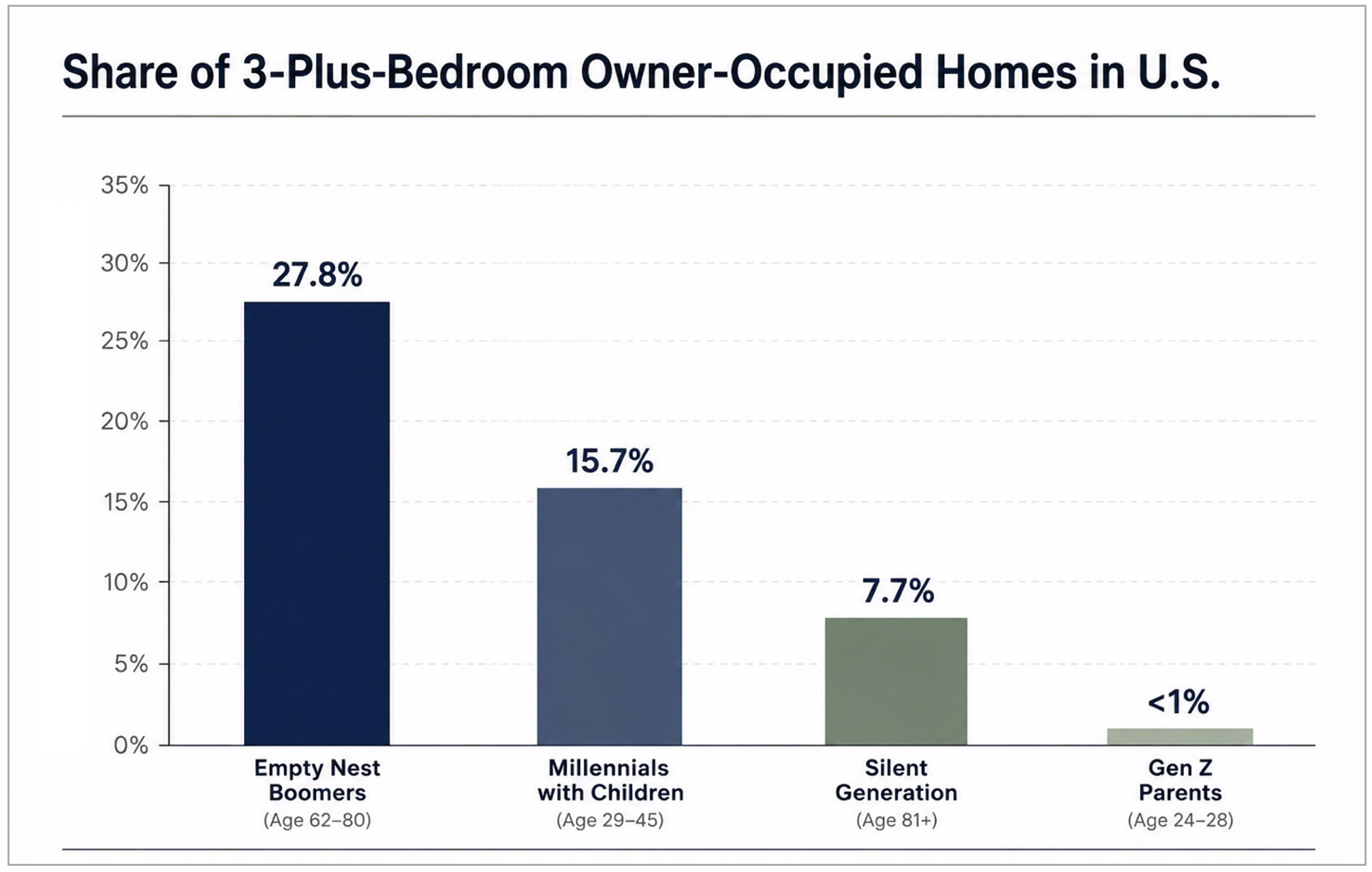
Source: Redfin analysis of U.S. census data from 2024 [Published April, 2026]
Nearly 78% of households age 65 and older own their homes. More importantly, Boomers continue to occupy a disproportionate share of the country’s larger houses. Empty-nest Boomers own nearly 27.8% of homes with three or more bedrooms, compared with 15.7% owned by Millennials with children. Based on trends over the last five generations, those numbers should be flipped. Instead, the Boomer share has barely changed in more than a decade. In 2014, Boomers owned 27.7% of larger homes in the U.S. That level has actually INCREASED 0.10% to present.
Older homeowners are not moving, and even when they do relocate, they are not downsizing. Homeowners in their 60s and 70s are transitioning into houses an average of only 100 square feet smaller, while owners over 80 are downsizing by only about 300 square feet.
At the same time, holding periods have stretched considerably. Among homeowners ages 79 to 99, 44% have been in their homes for more than 21 years.
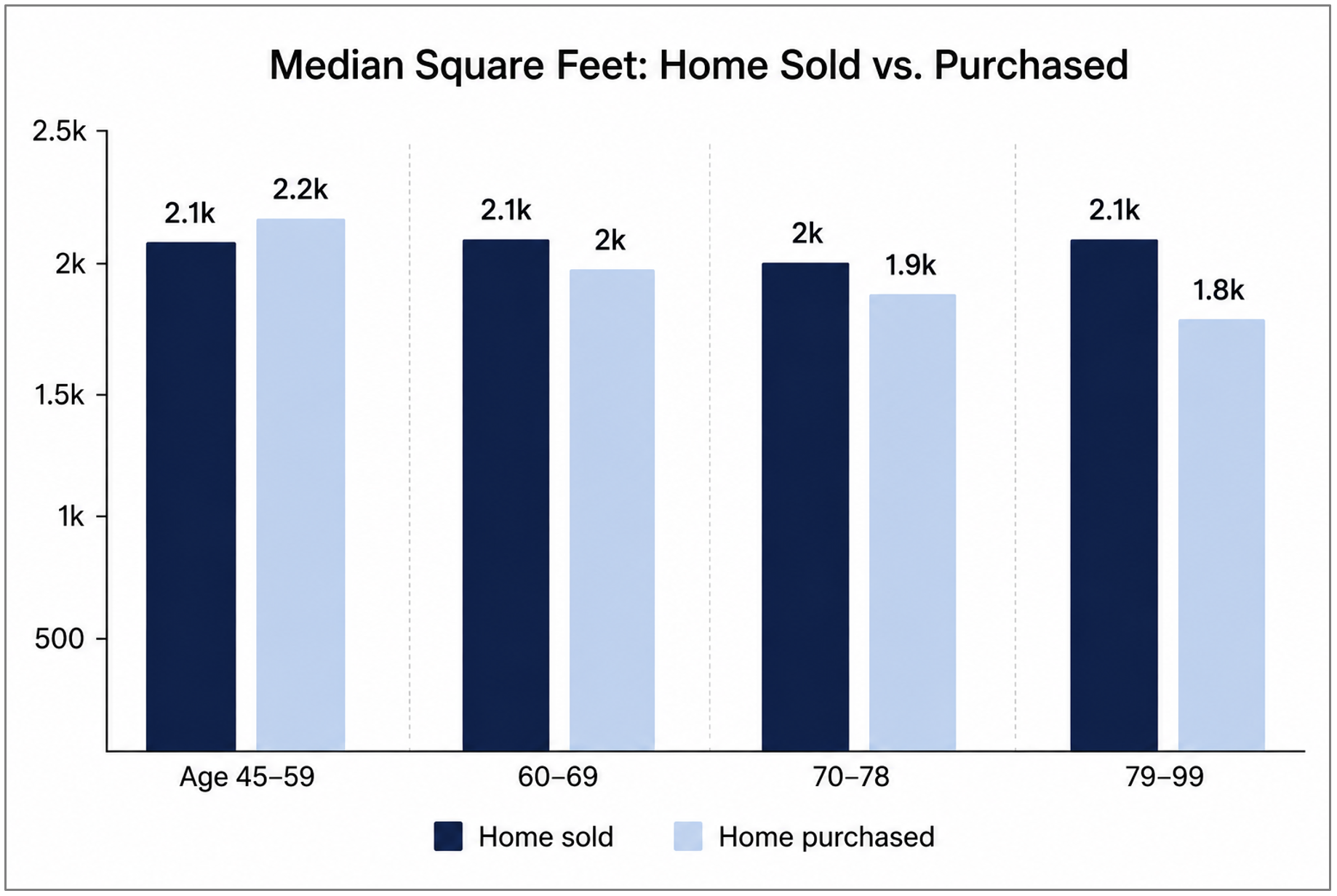
Source: NAR Home Buyers and Sellers Generational Trends Report [2025]
Why Doing Nothing Can Feel Rational
We have talked extensively about the “golden handcuffs” created by 3% mortgages. Still, I think another factor is becoming increasingly important, particularly in the higher-value markets: capital gains.
Consider a couple who bought a home for $400,000, invested another $100,000 into it, and today owns a property worth $2 million. After the $500,000 primary-residence exclusion available to a married couple, the owners could still have approximately $1 million in taxable gain.
At a 20% federal capital gains rate, that could mean a $200,000 tax bill.
Or they can keep the house. If the property passes to their heirs at death, current tax rules provide a step-up in basis to fair market value, potentially eliminating that embedded capital gain. From the homeowner’s perspective, waiting can suddenly look like the financially responsible decision.
But that analysis can be incomplete.
The Bigger Estate Planning Picture
What many homeowners ignore in their capital gains calculus is the penalty of the property passing into their estate. While the stepped up basis may help for capital gains tax, it penalizes the family in estate taxes. In Massachusetts, for example, after the $2 million estate-tax exemption, heirs will pay a 16% inheritance tax over the exemption. For a home valued at $2 million, the estate tax would be $320,000, considerably more than the $200,000 capital gain.
Selling can create liquidity for gifting, philanthropy, reinvestment or other goals. Owners could also reinvest to a home in lower (or zero) estate-tax states. Holding may seem like it makes more sense – but in reality, it limits your options to a single path.
These decisions should be evaluated with estate-planning, tax and financial advisors who understand your family’s complete financial picture, so that capital gains are not considered in isolation.
The most important question may not be “When should I sell?”, but instead, “What do I ultimately want this property to do for my family?”
A Tide, Not a Tsunami
All of this changes how I think about the long-predicted wave of Boomer inventory. I no longer expect a tsunami.
Properties will come to market unevenly, driven by health, family circumstances, financial markets, estate planning and other life events. These homes will move through the system, but more like a tide—gradually coming in and going out—instead of the single cascading event experts have been predicting.
If you are unsure about how the tide will affect you, please feel free to reach out to a LandVest expert – or email me at [email protected].
About Joseph L. Taggart

Joseph L. Taggart is President & CEO of LandVest and serves as the firm’s chief economist. A Yale-trained economist with more than 25 years of experience analyzing housing and macroeconomic trends, he provides perspective on the economic forces shaping housing markets, luxury real estate, and land and timber investment markets across the United States.



 To landvest.com



Follow Us on Social Media